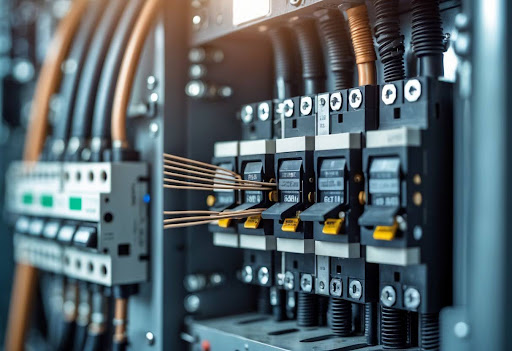
An air circuit breaker (ACB) is a specialized electrical device designed to protect circuits from overloads, short circuits, and ground faults. It uses air as the medium to extinguish the electrical arc that forms when the circuit breaker interrupts the current. This makes the ACB more effective and safer than regular breakers or fuses in controlling high currents and preventing damage.
Unlike normal breakers or fuses, an ACB can be adjusted to precise trip settings and reset quickly, allowing for flexibility in power distribution systems. Fuses, in contrast, must be replaced after they blow, and most standard breakers lack the speed and control required in certain high-capacity or sensitive environments.
Air circuit breakers also feature mechanical parts, like charging springs and arc chutes, that help them open and close rapidly while minimizing wear. This combination of speed, control, and arc extinguishing ability is why ACBs cannot be simply replaced by standard breakers or fuses in many industrial and commercial applications.
How an Air Circuit Breaker (ACB) Operates
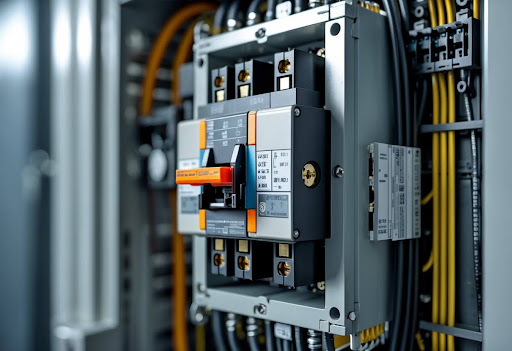
An Air Circuit Breaker (ACB) uses air to safely interrupt electrical current during fault conditions. Its design and operation rely on precise mechanical and electrical parts that manage high currents. The breaker’s response to faults depends on the spring mechanisms, contact separation, and arc extinguishing systems.
Construction and Main Components
An ACB consists mainly of the main contacts, arc chutes, charging spring, and auxiliary contacts. The main contacts carry the current and separate to break the circuit during faults. Arc chutes guide and cool the arc formed when contacts open.
The charging spring stores mechanical energy used to quickly close or open the breaker. Auxiliary contacts provide signals to control and protection devices. These parts are mounted inside a sturdy frame, often with a hand crank or motorized charging handle.
The breaker is designed for medium to low voltage applications, handling high current loads safely. It usually includes a locking mechanism for safety during maintenance.
Working Principle and Operation Sequence
The ACB operates by opening its main contacts when current exceeds a set limit. This is triggered by protection relays detecting faults like overloads or short circuits. When triggered, the breaker’s spring mechanism releases stored energy to separate the contacts rapidly.
Separating the contacts creates an electrical arc. Air inside the breaker helps extinguish this arc quickly using magnetic blowout arc chutes. These arc chutes cool and stretch the arc until it vanishes, stopping current flow.
The fast action minimizes damage to contacts and reduces downtime. After arc extinction, the breaker remains open until manually or automatically closed.
Breaker Operation and Trip Mechanisms
The breaker operation depends on its charging spring and trip system. Before use, the spring is wound to store energy. When a fault happens, trip coils or relays release the spring, causing the main contacts to open.
Trip mechanisms vary but often include thermal, magnetic, and electronic sensors. Thermal trips respond to long-term overload by detecting heat. Magnetic trips respond instantly to short circuits by sensing high current.
Auxiliary contacts signal the breaker’s status for remote monitoring or control. The breaker can be manually closed by pressing a button or sending an electrical command, releasing the charged spring to make contact.
This system allows quick and adjustable protection not possible with simple fuses or normal breakers.
Typical Applications and Use Cases of ACBs
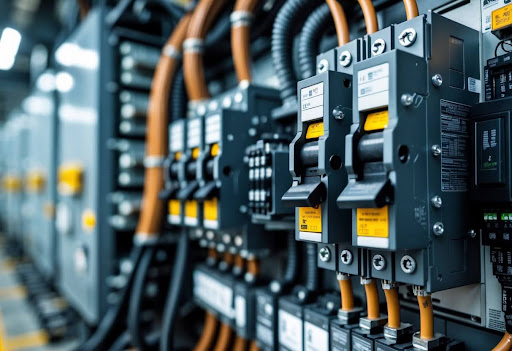
Air circuit breakers (ACBs) are used in different roles to protect and control electrical systems. They help manage power supply, prevent damage from faults, and ensure safety. Their design suits specific needs that normal breakers or fuses cannot meet in many situations.
Low-Voltage Main Switch Functions
ACBs often serve as the main switch in low-voltage power systems. They handle currents from about 800A to 10kA and operate up to 1kV. This makes them ideal for protecting large electrical panels and power supply systems in buildings.
They provide quick and reliable disconnection in case of overloads, short circuits, or earth faults. Unlike fuses, ACBs can be reset and adjusted for trip settings. This allows electricians to fine-tune protection based on system requirements. Their ability to break high currents safely without fire risks is key in main switch applications.
Branch Circuit Switch in Power Distribution
In power distribution, ACBs function as branch circuit switches. They protect individual feeder lines or sections connected to transformers, motors, or other equipment. ACBs can interrupt faults before they cause damage to the branch or spread to the main system.
Their precise trip control and fast arc quenching make them well suited for this role. Branch circuit switches need to operate frequently, and ACBs’ durability and adjustable settings enhance system reliability. Compared to normal breakers or fuses, ACBs reduce downtime and improve maintenance ease.
Role in Industrial and Commercial Electrical Systems
Industrial and commercial sites use ACBs to ensure stable and safe electrical operation. These breakers protect large machines, generators, and complex power circuits. They are essential where high fault currents and sensitive equipment exist.
ACBs support electrical systems by preventing equipment damage and avoiding power interruptions. Their capacity to handle high current loads and resist arc faults makes them preferred over simpler devices. Maintenance staff value ACBs for their electronic controls, which help monitor and test system health electrically and mechanically.
Why ACBs Cannot Be Replaced By Normal Breakers or Fuses
Air circuit breakers (ACBs) are designed for specific electrical needs that normal breakers and fuses cannot meet. Their unique features allow precise control and protection in high-current environments. Understanding their differences, advanced functions, and safety benefits explains why they remain essential in many power systems.
Difference Between ACBs, Normal Breakers, and Fuses
ACBs are heavy-duty devices used mainly in low voltage, high current applications, often handling currents from 800A to over 3000A. Unlike normal breakers, which rely on magnetic or thermal elements, ACBs use spring-loaded main contacts and an air blast or arc chute to quickly extinguish arcs.
Fuses are simpler devices that melt to break a circuit when overloaded, but they offer no reset capability. They must be replaced after operation. Normal breakers can be reset but have limited trip setting flexibility and slower operation than ACBs.
| Feature | ACB | Normal Breaker | Fuse |
| Current rating | High (800A to 6300A) | Low to medium | Varies, limited control |
| Trip settings | Adjustable/programmed | Fixed or limited | None |
| Reset capability | Yes, automatic/manual | Yes | No |
| Arc extinguishing | Air blast, arc chute | Magnetic/thermal | Melting element |
Advanced Features and Protections of ACBs
ACBs include features that protect power systems from damage and improve reliability. They can be programmed with precise trip settings, allowing electricians to dial in exact overload and short circuit limits. This flexibility prevents nuisance tripping and protects equipment better than fuses or standard breakers.
ACBs also support remote control and automatic reclosing, which helps restore power quickly after a fault clears. Their fast operation minimizes electrical arcs, preserving the breaker’s main contacts for longer service life. The internal arc chutes and blowout devices reduce fire and explosion risks by safely extinguishing arcs.
Safety, Maintenance, and Fault Tolerance
Using ACBs increases safety because of their robust construction and controlled arc extinguishing. They are less prone to dangerous failures compared to oil or gas breakers. Electricians can lock them out using locking devices, preventing accidental operation during maintenance.
While fuses require no periodic upkeep, ACBs need scheduled inspections to ensure springs and mechanical parts work correctly. This maintenance extends service life and reduces failure risk. Additionally, ACBs can detect faults within the circuit and prevent damage by tripping faster than normal breakers, improving overall system fault tolerance.
Troubleshooting, Maintenance, and Related Electrical Issues
Air circuit breakers (ACBs) require careful attention to keep them functioning safely and reliably. Issues with contacts, air flow, and external conditions can affect their performance. Proper inspection and maintenance help avoid failures and extend operating life.
Common ACB Faults and Solutions
ACBs often face problems like failure to trip, nuisance tripping, or false tripping. Failure to trip can occur from damaged or worn release mechanisms or faulty trip coils. Nuisance tripping may result from loose connections, incorrect settings, or contact contamination. False trips often indicate transient faults or sensor errors.
Checking for electrical continuity and inspecting mechanical parts is crucial. Technicians should examine trip coils and control circuits. Dirt or corrosion on contacts can cause poor conductivity, requiring cleaning or replacement. If the air supply system has a clogged air filter or compressor failure, arc extinction may be impaired, reducing breaker effectiveness.
Regular testing of the trip function ensures the ACB activates under fault conditions. If problems persist, consulting a qualified electrician is necessary.
Maintenance of Main and Auxiliary Contacts
Main contacts carry the load current and must be clean, properly aligned, and erosion-free. Arcing wears down these contacts over time, causing resistance and heating. Regular inspection involves checking for pitting or signs of burning. Polishing or replacement may be needed.
Auxiliary contacts control signaling and interlocking. They handle lower currents but are equally important for safe operation. Dust or oxidation on auxiliary contacts can interrupt control signals, so they also require cleaning.
During maintenance, power should be turned off and lockout procedures followed. If maintenance reveals frozen evaporator coils or issues with cooling in connected equipment like air conditioners, this signals possible environmental impacts needing correction.
Impact of External Factors on ACBs
Environmental conditions affect ACB performance. High humidity or dust can cause moisture or dirt buildup inside the breaker, increasing the risk of short circuits or insulation failure. Air circuit breakers with clogged air filters or inadequate ventilation risk overheating.
Altitude and temperature are important. ACBs are rated for specific ambient ranges, typically -5°C to +40°C. Higher temperatures or frozen parts can affect mechanical movements or electronic controls.
Mechanical vibrations from nearby equipment or electrical noise can interfere with control circuits. Preventive measures include installing proper enclosures and following manufacturer guidelines.
Routine checks for environmental stressors and HVAC system health, including compressor function and coil conditions, are essential for reliable operation.
Premium electrical and automation equipment
When it comes to electrical and automation equipment, quality is essential. Premium products provide enhanced safety, reliability, and performance. They help prevent hazards that can arise from using lower-quality devices.
Key Features of Premium Equipment:
- Safety Standards: Premium equipment often meets or exceeds international safety standards, ensuring it operates safely and efficiently.
- Durability: Quality materials and robust construction lead to longer lifespans, reducing the need for frequent replacements.
- Performance: High-end devices generally offer better efficiency, which can lead to lower energy costs and improved output.
Investing in premium equipment can significantly reduce risks. For instance, safety features are built-in to prevent electrical faults. Additionally, reputable brands provide proper certifications and guidelines, assuring users of their safety.
Examples of Premium Equipment Providers:
- Gabby Electric: Known for its extensive range of electrical products, Gabby Electric emphasizes quality and safety. Their offerings include automation solutions designed for various industries.
Benefits of Choosing Premium Brands:
- Peace of mind knowing safety is prioritized.
- Better support and warranty options.
- Access to the latest technology and innovations.
Purchasing premium electrical and automation equipment can enhance safety and performance while minimizing the risks associated with lower-quality products.